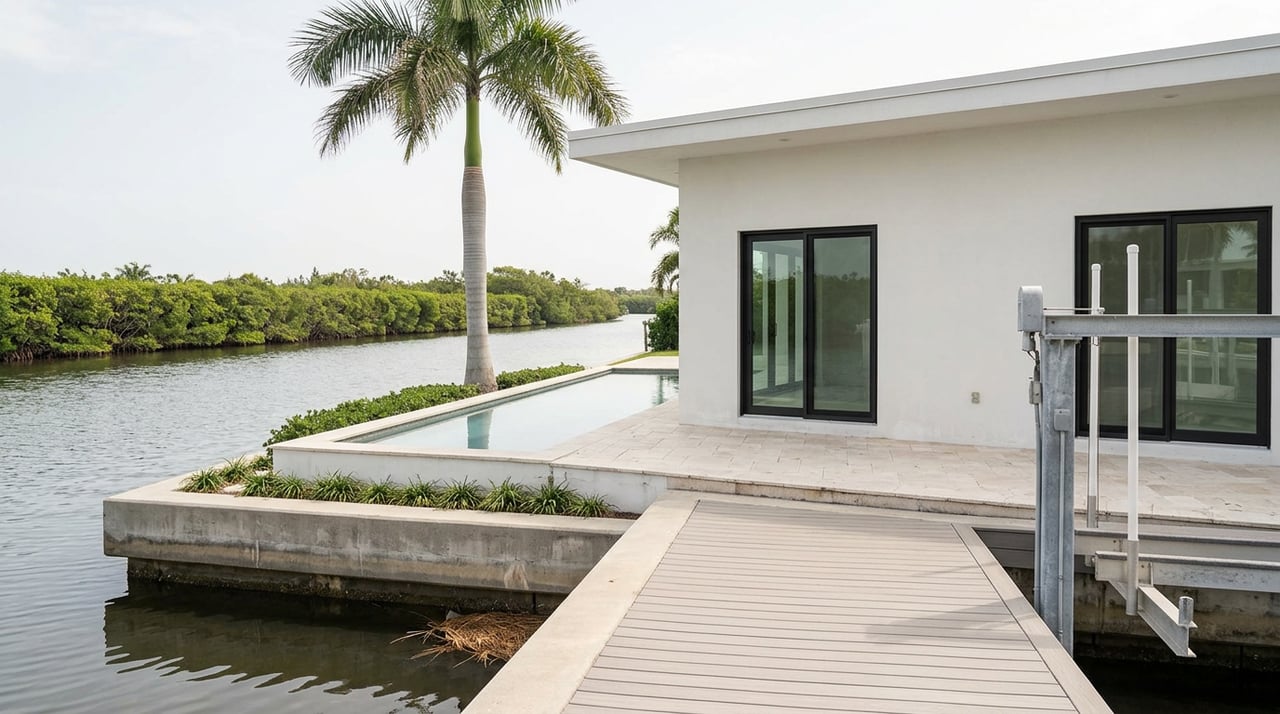
Two waterfront homes on the same block in Lighthouse Point, priced within a few percentage points of each other, both carrying the same line in the listing description: no fixed bridges, direct ocean access. On paper they read as interchangeable. One buyer's boat clears the run to Hillsboro Inlet in fifteen minutes with room to spare. The other discovers, after closing, that the water at the berth drops to a foot and a half at low tide.
Both homes were telling the truth. Neither was telling the whole story. In this market, the phrase that shows up on nearly every canal listing is doing less work than buyers assume, and the gap between what it implies and what it actually confirms is where real money moves.
The Bridge Clearance Number Nobody Puts in the Listing
"No fixed bridges" is a specific claim: the route from that particular dock to open water does not pass under a stationary span. It says nothing about the drawbridge at the inlet itself, and it says nothing about how much of your transit time gets eaten by slow zones before you get there.
The Hillsboro Inlet drawbridge on A1A, the crossing most Lighthouse Point boaters use to reach the Atlantic, has a reported closed vertical clearance of about 13 feet, current as of information gathered in March 2026. If your air draft is under that, the bridge is rarely more than a minor delay. If it isn't, you're timing your trips around an opening schedule, and that schedule is not listed on the MLS sheet next to the price.
Layer on the no-wake and idle-speed segments near marinas, ramps, and the inlet approach itself, and two "no fixed bridges" homes can have meaningfully different real-world transit times to the ocean. That difference doesn't show up when you're comparing list prices side by side. It shows up the first week you own the boat.
What the Canal Doesn't Tell You Until Low Tide
Canal-front ownership only works if the boat you intend to keep can reliably float where you plan to berth it. Depth at the dock, measured at mean low water rather than at whatever tide happened to be running during your showing, is the second gatekeeper after bridge clearance, and it's the one buyers most often skip.
A showing scheduled at high tide can make a shallow berth look perfectly adequate. A sounding taken at low tide tells you what you're actually buying. Shoaling and current strength near the inlet can shift over time, which is part of why local guidance consistently points buyers toward ordering a recent depth sounding, and toward treating that sounding as a condition of the offer rather than a nice-to-have.
None of this is exotic advice. It is standard due diligence for anyone buying on a canal in this town. It just rarely gets mentioned in the listing copy that leads with "no fixed bridges" and stops there.
The Seawall Bill Waiting Behind the View
Here is the fact that changes how a waterfront purchase should be underwritten: Broward County's regional standard requires new or substantially repaired tidal flood barriers, seawalls included, to meet elevation requirements.
If you're planning new construction or a substantial renovation on a waterfront lot in Lighthouse Point, the city's own building department requirements go further. The City of Lighthouse Point's single-family residence requirements state that, for a new single-family home on the water, the permit package must include three signed and sealed letters from a licensed engineer confirming the seawall's condition and its ability to support the proposed upland improvements. That is not a line item you negotiate around after the fact. It is a document you need before the city issues a permit at all.
The City of Lighthouse Point's checklist for permitting docks, seawalls, and boat lifts spells out the same layered approval process: building, electrical, and plumbing applications, outside agency sign-off from Broward County or the Army Corps of Engineers where applicable, and signed and sealed plans for anything beyond routine repair. None of this is disclosed in a listing photo of a clean concrete cap and a tidy dock. It surfaces in the permit history, and permit history is something a buyer has to go looking for.
The Cranes Are Already Out on the Canals
This isn't a hypothetical someday cost. It's happening on Lighthouse Point's canals right now. The city itself has an active capital project installing riprap revetment at four locations along its own seawalls to protect against erosion at stormwater outfalls, and a separate drainage and roadway improvement project along NE 21st Avenue that began in the first week of January 2026 and was expected to run roughly nine months.
Private marine contractors have been just as busy on residential seawalls across town through the year, with pile-jacket and resurfacing work completed in Lighthouse Point in the summer, a raised seawall cap brought up to Broward County standards in the spring, and a boat lift reinstallation completed as recently as September 2026. Seawalls in this market are aging into a repair and permit cycle at the same time buyers are shopping the homes behind them, which is exactly why the condition of the wall matters as much as the condition of the kitchen.
Why the Headline Price Doesn't Explain the Spread
Put the pricing data next to this and the picture gets clearer. As of mid-2026, waterfront listings in Lighthouse Point were clustered around a $799,000 median across roughly 80 active listings, while the town's broader home value index sat closer to $771,700, up only modestly year over year. At the top of the market, the over-$5-million tier recorded just a single closed sale in the second quarter of 2026, a thin enough sample that any single transaction swings the average.
A market with a tight median and a thin trophy tier is not a market where price alone explains value. It's a market where the spread between two similarly priced homes gets explained by exactly the three things a listing sheet doesn't volunteer:
| What to verify | Why it moves the outcome |
|---|---|
| Bridge clearance and route timing to the inlet | Determines whether "no fixed bridges" applies to your actual boat and how long the real trip takes |
| Depth at the dock, measured at low tide | Sets the ceiling on what vessel the property can actually support year-round |
| Seawall elevation and permit history | Flags whether the wall meets Broward County's tidal barrier standard and whether repairs are already due |
The Comparison That Actually Matters
None of this means waterfront homes in Lighthouse Point are riskier than they look. It means the risk and the value both live in details that require a phone call, a permit search, and a sounding line rather than a scroll through photos. Two "no fixed bridges" listings priced within a few thousand dollars of each other can represent very different purchases once you know what's under the water and behind the seawall cap.
For a buyer treating this home as both a lifestyle decision and a financial one, that distinction is the actual comparison. The asking price tells you what the seller wants. The bridge clearance, the low-tide depth, and the seawall's permit history tell you what you're getting.
A Few Questions Worth Asking Before You Write an Offer
Does "no fixed bridges" mean I can get to the ocean in any boat? No. It means the route from that specific dock avoids stationary spans. Your air draft against the Hillsboro Inlet drawbridge's clearance, and the no-wake zones along the way, still determine your actual transit time.
How do I find out if a seawall meets the county standard? Request the property's permit history and any recent survey or elevation certificate showing the top-of-seawall elevation in NAVD88, then compare it against Broward County's tidal barrier standard. If the wall was never permitted or hasn't been inspected recently, treat that as a condition to resolve before closing, not after.
Who handles the approval if I want to repair or replace a seawall myself? Expect review from the City of Lighthouse Point's building department at minimum, with Broward County, the Florida Department of Environmental Protection, or the Army Corps of Engineers involved depending on the scope of the work. The city's own permitting checklist lays out what each application needs to include.
Waterfront value in Lighthouse Point rewards buyers who ask about the water before they fall for the view. If you're comparing canal-front listings, or wondering what your own dock, seawall, and boating access are actually worth in today's market, Karen Baker P.A. can walk you through the numbers that matter beyond the asking price. Request Your Home Valuation and get a read on what your property, and its water, are really bringing to the table.
This article is general information, not legal, tax or financial advice. Consult a qualified professional about your situation.
