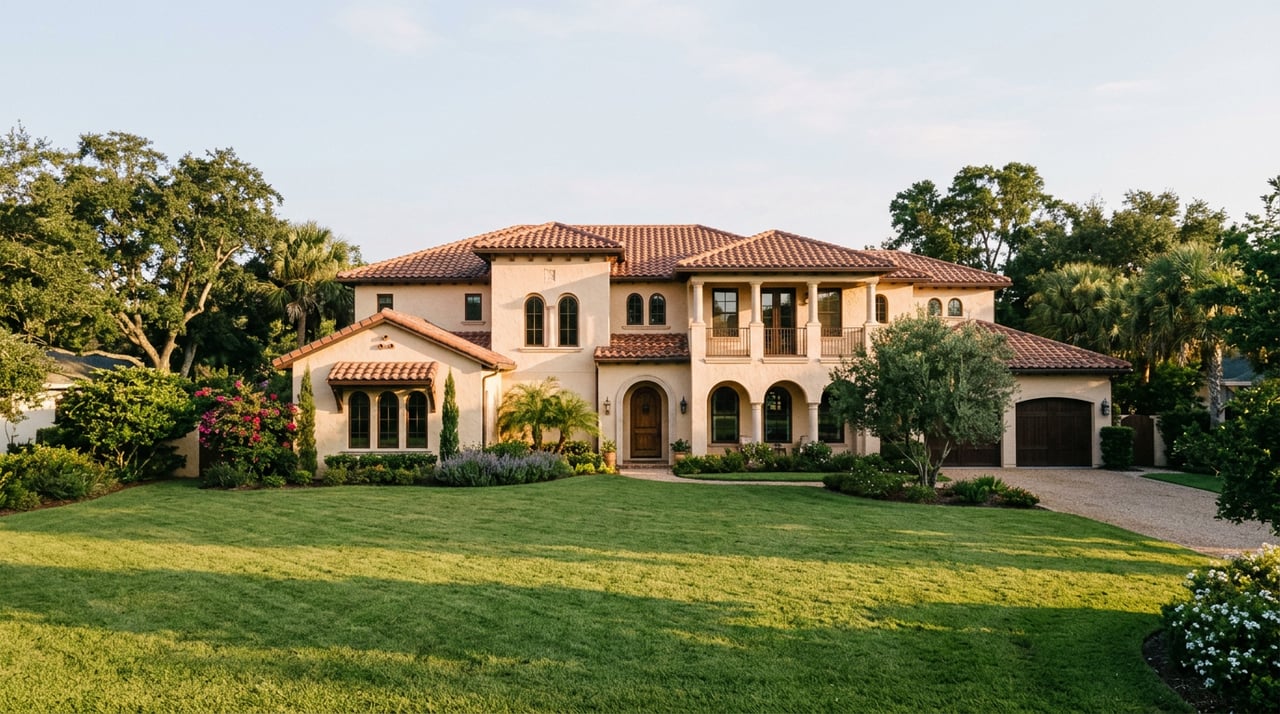
Drive past the corner of West Palmetto Park Road and Cardinal Avenue and you will see a small bronze marker, easy to miss if you are not looking for it. It tells a story most of the neighborhood already half knows: that these streets, laid out under palms and barrel tile roofs, are Boca Raton's oldest surviving subdivision. What the marker does not tell you is the version of events that actually explains why Old Floresta looks and feels the way it does today.
A few miles east, The Boca Raton spent this year proving it knows how to throw a party. The resort's centennial arrived with a $375 million property-wide reinvention, a new museum, an Assouline coffee-table book, and a closing weekend that included a nearly 14-foot spinning cake, 75 synchronized drones, and a fireworks finale with more than 3,000 bursts. It earned 24 stars in Forbes Travel Guide's 2026 Star Awards along the way.
Old Floresta turned 100 around the same time. Nobody sent an invitation. But the neighborhood's version of that same year is, if anything, the more interesting story, because the thing that actually built these streets was not a vision. It was a bankruptcy.
The same contractor built both
Here is the detail that gets lost in most retellings: the company that constructed the Cloister Inn, the 1926 hotel that became The Boca Raton, is the same company that was contracted to build the 29 Mizner-designed houses that became Old Floresta. The Robinson Company, a New York contractor, won both jobs. For a short stretch in the mid-1920s, the crews framing out the grand hotel on Camino Real and the crews framing out modest executive houses a few blocks away were, in effect, working for the same client on the same architectural vision.
Then the money ran out. The real estate boom that had been inflating South Florida property values since the early 1920s collapsed in 1926, and the Mizner Development Corporation went under before Robinson could finish the houses. The hotel survived because it had already opened its doors and found its own financial footing. The neighborhood did not have that luxury. It sat half-built, mortgaged to a group of Chicago investors who now had every legal right to walk away.
They did not walk away. Hermann von Holst, the Chicago partner who held the mortgage, foreclosed on the unfinished project and then did something unusual for a foreclosure: he finished the job himself. He supervised construction of the remaining houses, and in the process he made a decision that still shapes how residents describe their own address today. He renamed the streets after flowering plants and gave the subdivision its name, calling it Floresta, a Spanish phrase for a delightful rural place. The Mediterranean architecture is Mizner's. The floral street grid, the actual identity of the place, belongs to the man who bought it out of bankruptcy.
"The Cloister Inn is as fine a hotel as I know of anywhere, and a creation of singular beauty."
That was financier Otto Kahn's assessment of the resort in March 1926, right around the same season von Holst was quietly finishing a subdivision the original developer could no longer afford to complete.
What actually survives from that year
Two houses inside Old Floresta carry the paper trail. The Fred C. Aiken House, at 801 Hibiscus Street, was built in 1926 and added to the National Register of Historic Places in 1992. Aiken was a film industry executive who invested in finishing the neighborhood alongside von Holst in 1927, then went on to serve ten years as Boca Raton's mayor and another ten as town clerk, living in the house for 31 years total. The Lavender House, at 875 Alamanda Street, also built in 1926, made the National Register in 1995. Von Holst himself moved in two years after it was completed and lived there until his death in 1953, staying active in the community the entire time.
In 1990, the City of Boca Raton's Historic Preservation Board formally created the Old Floresta Historic District, making it the city's first. The Boca Raton Historical Society's very first home tour, back when the society was still a young organization working out of the restored Old Town Hall, was held right here in Old Floresta rather than at any of the city's more famous addresses.
Set the two centennials side by side and the contrast holds up under nearly every measure.
| Centennial marker | The Boca Raton (resort) | Old Floresta (neighborhood) |
|---|---|---|
| The spend | $375 million property-wide reinvention | No renovation budget, just a preservation board and a deed history |
| The proof on paper | 24 stars in Forbes Travel Guide's 2026 Star Awards | Two houses on the National Register of Historic Places |
| The party | A closing weekend with a 14-foot cake, 75 drones, and 3,000-plus fireworks bursts | A modest home tour tradition that predates most of the city's current civic calendar |
| Who actually built it | The Robinson Company | The Robinson Company, a few blocks away, before running out of money |
Where the story is still visible this fall
The resort's centennial machine has been running since January, but the Boca Raton Historical Society keeps its own quieter calendar going year-round, and this fall's lineup happens to line up well with the neighborhood's own history. Between late July and late October, the society's schedule includes a guided walking tour through The Boca Raton itself, tracing the property's evolution and pointing out which details are original Mizner work and which came later, plus separate evenings at the Schmidt Boca Raton History Museum built around music of the 1930s and 1970s. None of it requires a special occasion. It is simply what the society does most months of the year, and it happens to be especially active right now.
A few ways to actually see the parts of this story that sit inside Old Floresta itself:
- Walk or drive Hibiscus Street to see the Aiken House and Alamanda Street for the Lavender House. Both are private residences, so the interest is architectural and historical rather than a reason to knock on the door.
- Stop at the marker itself, at West Palmetto Park Road and Cardinal Avenue. It was placed there in 2008 by the Historical Society and the Florida Department of State as an official Florida Heritage Site, and it is the shortest possible summary of everything above.
- Download the Historical Society's free GeoTourist driving tour app, which routes visitors and residents alike past the city's historic sites, Old Floresta included, with narration along the way.
- If the resort's own centennial museum interests you, the Cloister Inn Museum opened in December 2025 in partnership with the Historical Society and includes a self-guided audio tour built around preserved original furnishings.
- The city's Centennial Nights Night Market continues its monthly run at Sanborn Square on North Federal Highway, a low-key way to spend an evening downtown that has nothing to do with real estate and everything to do with why people like living here in the first place.
The part that actually holds up
The easy version of the Old Floresta story is the one on most listing sites: Mizner-designed, historic, charming. All true, and all a little flat. The version that holds up under scrutiny is stranger and better. This neighborhood exists because a real estate boom collapsed, a development company went bankrupt, and a Chicago mortgage holder finished the job. The flower names on your street sign are not a developer's marketing flourish. They are what was left standing after the original vision ran out of money, given their names by the man who completed the remaining houses.
A hundred years is a long time for a neighborhood to still look like the thing it was originally built to be, especially one that almost did not get built at all. That is worth knowing whether you have lived on these streets for thirty years or three.
If you are curious about the history behind a specific address in Old Floresta, or just want to talk about what a century of continuity like this actually means for a street's character, Karen Baker has spent more than two decades paying attention to this particular corner of Boca Raton and is always glad to compare notes. Request Your Home Valuation whenever the conversation turns practical, but the history is worth a conversation on its own.
